

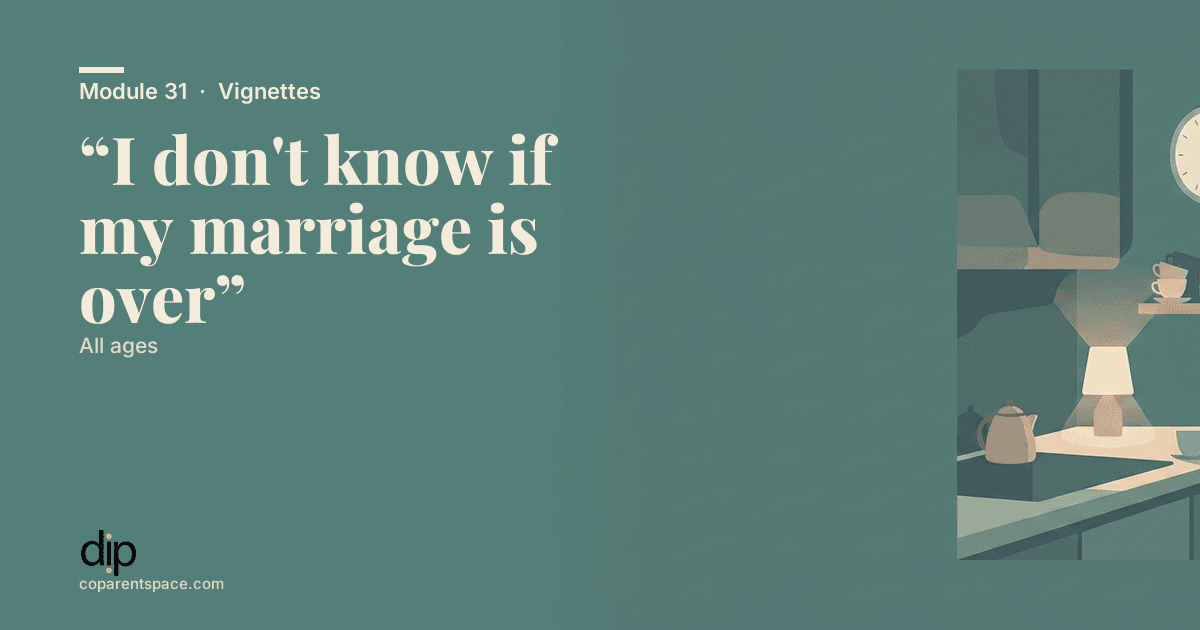
The house is finally quiet. The children went down an hour ago, the dishes are done, and your partner is in the other room with the television murmuring through the wall. You're standing in the kitchen with a cold cup of tea you forgot to drink, and the thought arrives the way it has been arriving for months now, quietly, almost politely. I don't know if this is over.
Not "I want it to be over." Not "I've decided." Just, I don't know. And you're so tired of not knowing.
If that's where you are, it helps to say plainly that the not-knowing is its own kind of exhausting, separate from whatever is wrong in the marriage itself. Deciding is hard. Not being able to decide, for weeks or months, while you carry on making lunches and saying goodnight and lying next to someone you can't read anymore, is a particular weight that doesn't get talked about much.
It shows up in odd places. A friend asks how things are and you hear yourself say "fine, busy," and you don't know if that's a lie. You catch a good moment, a real one, the whole family laughing at something at dinner, and instead of just having it you find yourself studying it, asking whether it means you should stay, as if every ordinary evening is now evidence in a case you can't stop running. The not-knowing turns your own life into something you watch from a small distance, and that's tiring in a way that's hard to explain to anyone who hasn't been there.
You might have assumed that by now you'd know. That a person is supposed to be able to tell whether their own marriage is ending. But a lot of people can't, not for a long time, and not because they're avoiding it. The not-knowing is a real place, and you're standing in it honestly.
Here's something to sit with, gently. There's a difference between "I want out" and "I don't know," and it matters more than it seems. People who are genuinely done, who have truly left the marriage on the inside, mostly don't stand in kitchens at night agonizing like this. The agonizing tends to mean something is still there. Not necessarily enough. But something. The fact that you can't easily answer the question is, itself, an answer to a different question, the question of whether anything remains. Something does, or this would be simpler.
For some people reading this, the honest truth will turn out to be that they are done, and that the not-knowing was the slow work of letting themselves admit it. If that's you, that's a real answer, and a hard-won one. But for a great many people, the not-knowing is something else. It's the gap between a marriage that's hard and a marriage that's over, and that gap is wider, and more workable, than it feels at night.
You don't have to resolve any of this tonight. That's the part the kitchen-at-eleven feeling gets wrong. It tells you that you should already have decided, that the not-knowing is a failure. It isn't. The next honest step was never going to be the decision. It's smaller than that. It's finding out whether there's something here to work with, and that's not a thing you can do alone in a quiet kitchen. It's a thing you do slowly, often with help, in daylight.
You pour out the cold tea. The television still murmurs through the wall. Nothing is decided, and for tonight, nothing has to be. Tomorrow there might be a smaller question than the one you've been carrying. Not whether this is over, but whether there's something still worth finding out. That one, you can begin.
This is supportive self-help, not medical, psychological, or legal advice, and no substitute for a qualified professional. If you or your child may be in danger, contact your local emergency services.